
How to Calculate Digital Marketing ROI: 5 Formulas That Actually Work
You spent $15,000 on marketing last quarter. Revenue went up. But did those campaigns actually drive that revenue, or would it have happened anyway?
This question haunts every marketer who has ever tried to justify their budget to leadership. Without accurate ROI measurement, you are essentially gambling with company money and hoping for the best.
The good news: calculating digital marketing ROI is not as complicated as it seems. You need the right formulas, the right metrics, and a reliable system for tracking which campaigns actually drive results.
In this guide, you will learn exactly how to calculate digital marketing ROI using five proven formulas, understand what benchmarks to aim for by channel, and build a tracking foundation that makes ROI measurement accurate and actionable.

What is Digital Marketing ROI?
Digital marketing ROI (Return on Investment) is a performance metric that measures the profit or loss generated by your digital marketing campaigns relative to the amount spent. It tells you whether your marketing efforts are making money or losing money.
The basic concept is simple. If you invest $1,000 in a Facebook ad campaign and generate $5,000 in sales, you made money. If that same $1,000 only generates $500 in sales, you lost money. ROI quantifies this relationship as a percentage.
ROI matters because marketing budgets are not unlimited. Every dollar spent on email marketing is a dollar not spent on paid ads, SEO, or content. Knowing which channels deliver the highest returns helps you allocate budget where it counts.
According to research, businesses that calculate ROI are 1.6x more likely to receive additional marketing budget. Numbers speak louder than intuition in budget conversations.
What is the Formula for Digital Marketing ROI?
The basic digital marketing ROI formula is:
ROI = ((Revenue – Marketing Cost) / Marketing Cost) x 100
This formula works for most situations, but different scenarios call for variations. Here are five formulas you should know:
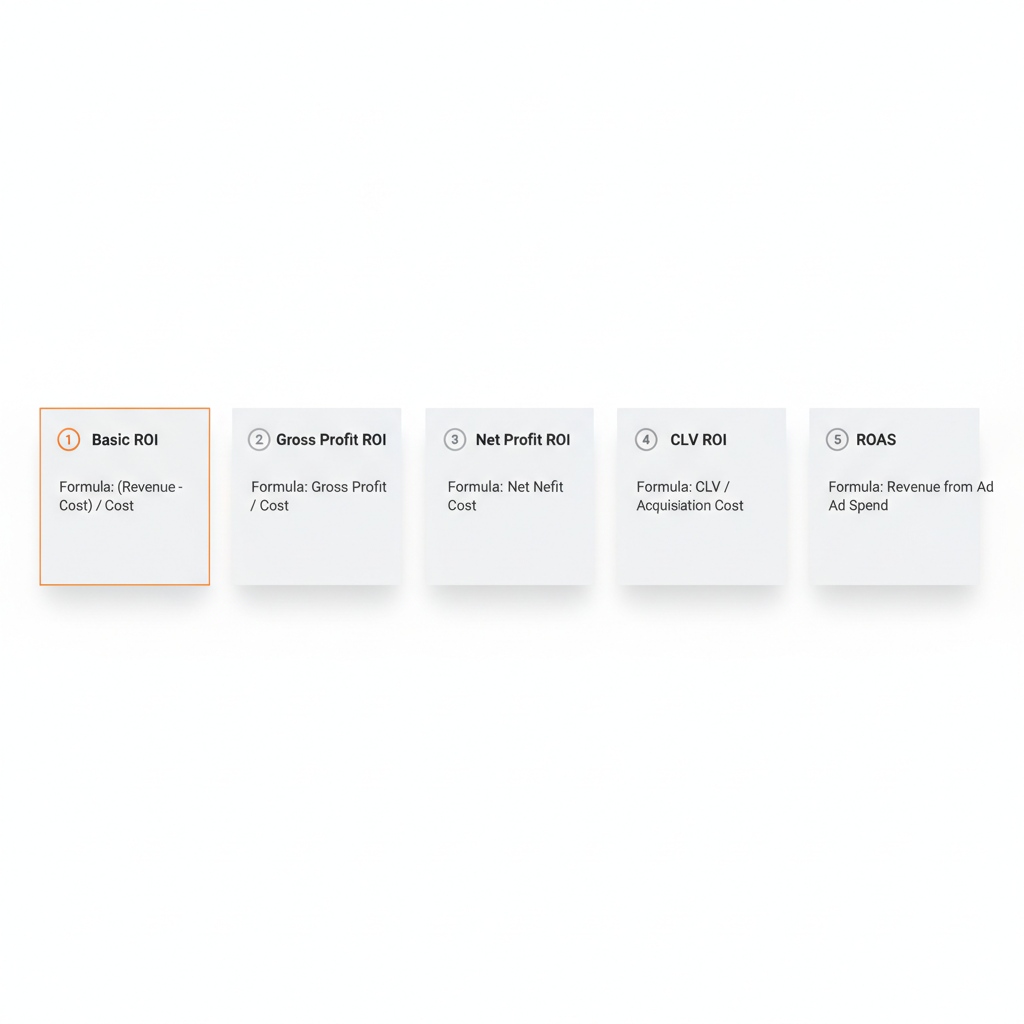
Formula 1: Basic ROI
ROI = ((Revenue – Cost) / Cost) x 100
Use this for quick campaign snapshots. If you spent $5,000 on Google Ads and generated $20,000 in revenue, your ROI is 300%. You earned $3 for every $1 invested.
Formula 2: Gross Profit ROI
ROI = ((Revenue – COGS – Marketing Cost) / Marketing Cost) x 100
This formula accounts for the cost of goods sold (COGS). For e-commerce businesses, this gives a more accurate picture because it subtracts product costs from revenue before calculating return.
Formula 3: Net Profit ROI
ROI = ((Gross Profit – Operating Expenses) / Marketing Cost) x 100
The most accurate formula for true profitability. It factors in overhead, salaries, and other expenses. Use this when reporting to executives who care about bottom-line impact.
Formula 4: Customer Lifetime Value (CLV) ROI
ROI = ((CLV x New Customers – Marketing Cost) / Marketing Cost) x 100
For subscription businesses or companies with repeat customers, this formula captures long-term value. If your average customer is worth $2,000 over their lifetime and your campaign brought in 50 new customers, that is $100,000 in lifetime revenue, not just the first purchase.
Formula 5: Return on Ad Spend (ROAS)
ROAS = Revenue / Ad Spend
Technically not ROI, but often confused with it. ROAS only measures advertising efficiency and does not account for other costs. A 4:1 ROAS means $4 in revenue for every $1 in ad spend. Use it for comparing ad performance, not overall profitability.
What Metrics Do You Need to Calculate Marketing ROI?
Accurate ROI calculation requires tracking specific metrics across your marketing activities. Without these data points, your calculations will be incomplete or misleading.
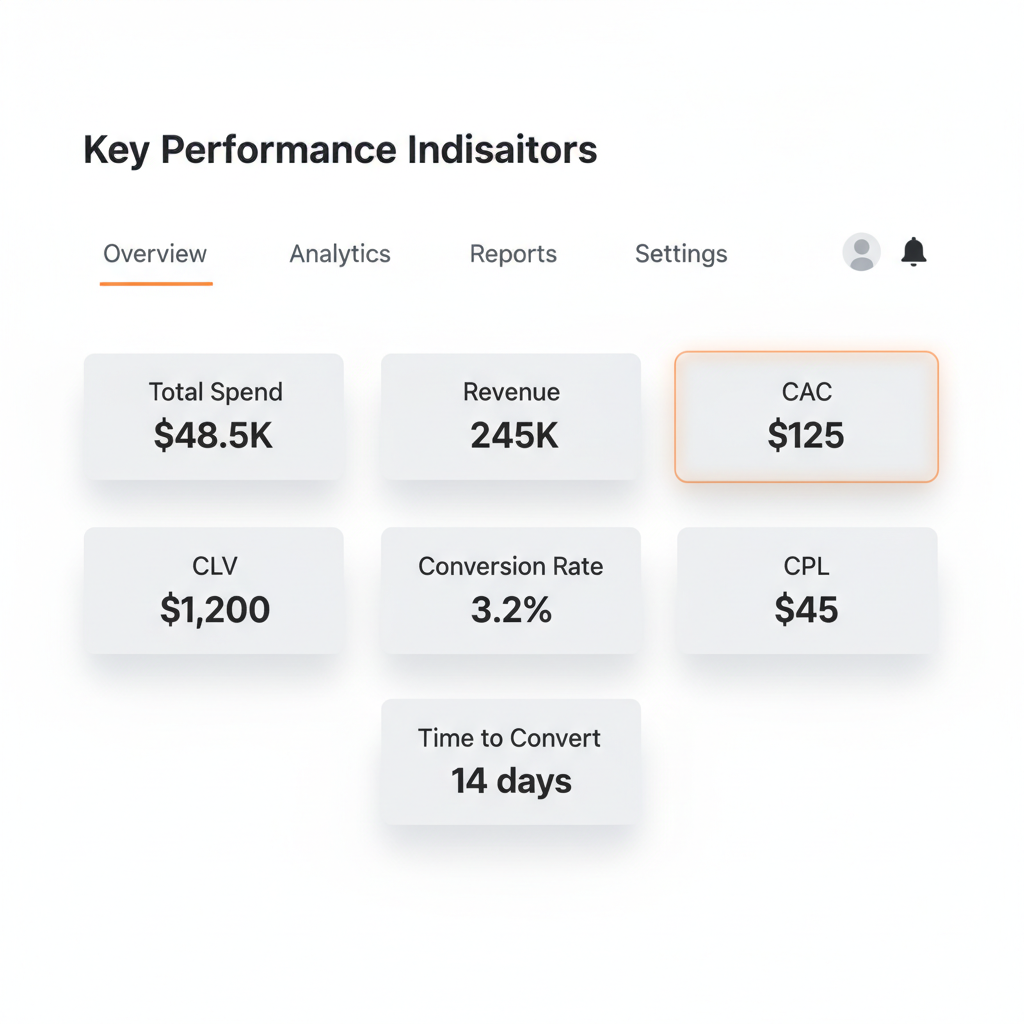
1. Total Marketing Spend
Include every cost associated with your campaigns:
- Advertising spend (PPC, social ads, display)
- Tool and platform subscriptions
- Agency fees or contractor costs
- Team salaries allocated to marketing
- Content creation costs (design, copywriting, video)
- Overhead allocation
Forgetting indirect costs artificially inflates your ROI. Be thorough.
2. Revenue Attribution
The trickiest metric to track accurately. You need to know exactly which campaigns drove which sales. This is where UTM parameters become essential. They tag your links so analytics platforms can attribute revenue to specific campaigns, channels, and content.
3. Customer Acquisition Cost (CAC)
Customer acquisition cost (CAC) is the total cost of acquiring a new customer, including all marketing and sales expenses divided by the number of new customers acquired.
Formula: CAC = Total Marketing + Sales Cost / New Customers Acquired
If you spent $50,000 on marketing and sales and acquired 100 customers, your CAC is $500.
4. Customer Lifetime Value (CLV)
Customer lifetime value (CLV) is the total revenue a business expects to earn from a single customer throughout their entire relationship.
Formula: CLV = Average Purchase Value x Purchase Frequency x Customer Lifespan
If customers spend $100 per order, order 4 times per year, and stay for 3 years, CLV is $1,200.
5. Conversion Rates by Channel
Track how often visitors become leads and leads become customers for each channel. This helps identify which channels are efficient (high conversion) versus those that are leaky (low conversion).
6. Cost Per Lead (CPL)
Cost per lead (CPL) measures how much it costs to generate one qualified lead through marketing efforts.
Formula: CPL = Campaign Cost / Number of Leads Generated
B2B average CPL is $942 for organic marketing and $1,907 for paid channels.
7. Time to Conversion
Some channels convert quickly (PPC), others take months (SEO, content). Knowing your average time to conversion prevents premature ROI calculations that undercount long-term channel value.
How Do You Calculate ROI by Marketing Channel?
Different marketing channels have vastly different ROI profiles. Understanding benchmarks by channel helps you set realistic expectations and identify underperformers.
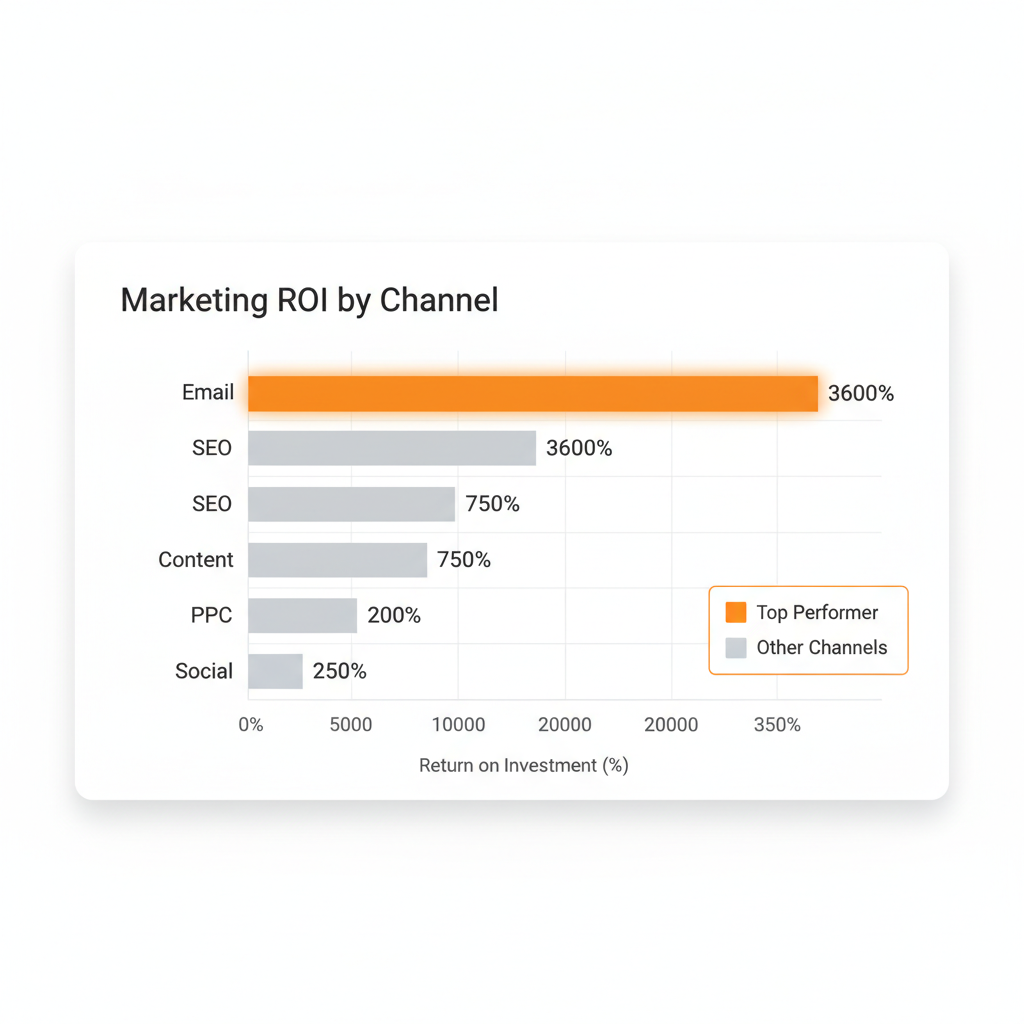
Email Marketing ROI
Average ROI: 3,600% ($36 for every $1 spent)
Email consistently delivers the highest ROI of any digital channel. Calculate it by tracking revenue from email-attributed sales (using UTM tracking for email campaigns) minus all email marketing costs (platform, design, list management, labor).
Example: $2,000 monthly email costs generate $74,000 in attributed sales. ROI = (($74,000 – $2,000) / $2,000) x 100 = 3,600%
SEO ROI
Average ROI: 748% (over 3-year average)
SEO requires patience. Most businesses see meaningful ROI after 6-12 months of consistent effort. Calculate by attributing organic search revenue (tagged with UTM parameters for organic campaigns) to your SEO investment including content, technical optimization, and link building.
The 22:1 ratio (2,200% ROI) reported by some studies reflects mature SEO programs. New programs should expect lower initial returns that compound over time.
Content Marketing ROI
Average ROI: 500-1,000% (long-term)
Content builds permanent assets that generate traffic for years. Calculate by tracking leads and sales attributed to content pieces. Include creation costs (writers, designers, editors), distribution costs, and promotion costs.
Content marketing ROI improves over time as individual pieces accumulate traffic and links.
PPC Advertising ROI
Average ROI: 200% ($2 for every $1 spent)
PPC delivers immediate results but typically lower ROI than organic channels. The tradeoff is speed and control. Calculate using ad spend plus management costs against attributed conversions.
Facebook Ads and Google Ads consistently rank as top ROI performers in paid advertising. Track using UTM best practices to attribute conversions accurately.
Social Media ROI
Average ROI: 100-400% (organic)
Organic social media ROI is challenging to measure because much of the value is brand awareness and engagement rather than direct conversions. Focus on attributable actions: link clicks, lead form completions, and sales tracked via UTM parameters.
Paid social typically outperforms organic for direct response but requires ongoing spend.
Why is Marketing ROI Hard to Measure?
If ROI calculation were straightforward, every marketer would do it perfectly. Reality is messier. Understanding the challenges helps you build systems that overcome them.
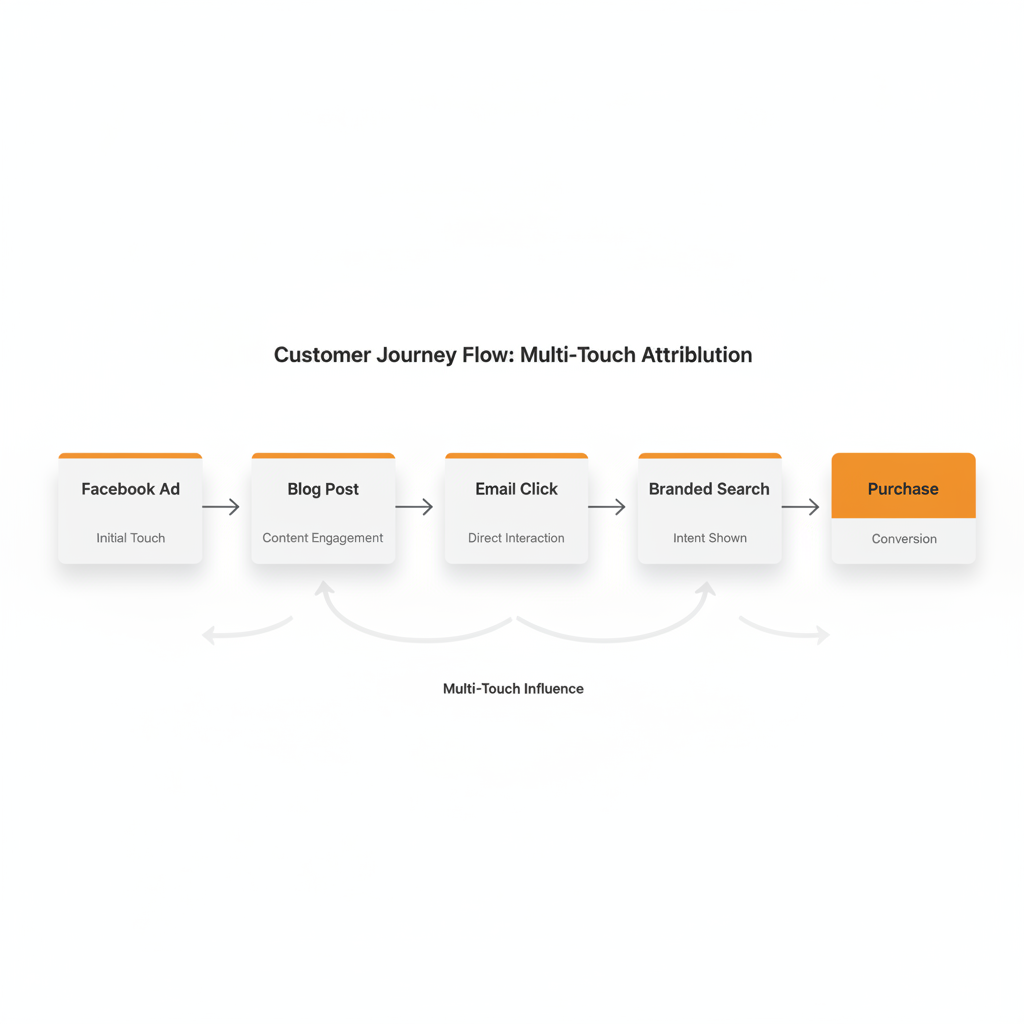
The Multi-Touch Attribution Problem
Marketing attribution is the process of identifying which marketing touchpoints contributed to a conversion or sale. The challenge: customers rarely convert on the first touchpoint.
A typical journey might look like this:
- See Facebook ad (awareness)
- Read blog post from organic search (research)
- Click email link (engagement)
- Return via branded search and purchase (conversion)
Which channel gets credit? Last-click attribution gives all credit to branded search. First-click gives it to Facebook. Neither tells the complete story.
Multi-touch attribution models distribute credit across touchpoints. Linear models split evenly. Time-decay models weight recent touches more heavily. Position-based models emphasize first and last touches.
Dark Social and Untrackable Channels
According to Content Marketing Institute data, 15-25% of conversions have incomplete attribution. This “dark social” includes:
- Private messaging (WhatsApp, Slack, DMs)
- Email forwarding
- Direct URL copying
- Word of mouth referrals
You cannot track what you cannot see. Accept that some attribution will always be incomplete.
Long Sales Cycles
B2B sales cycles average 3-6 months. If you calculate ROI after 30 days, you will massively undercount the value of top-of-funnel campaigns. Align measurement windows with actual sales cycles.
Privacy and Tracking Limitations
Ad blockers, browser privacy features, and regulations like GDPR limit tracking capabilities. First-party data (like UTM parameters) becomes more valuable as third-party cookies disappear.
How Do You Calculate Digital Marketing ROI Step-by-Step?
Follow these six steps to calculate ROI for any marketing campaign:
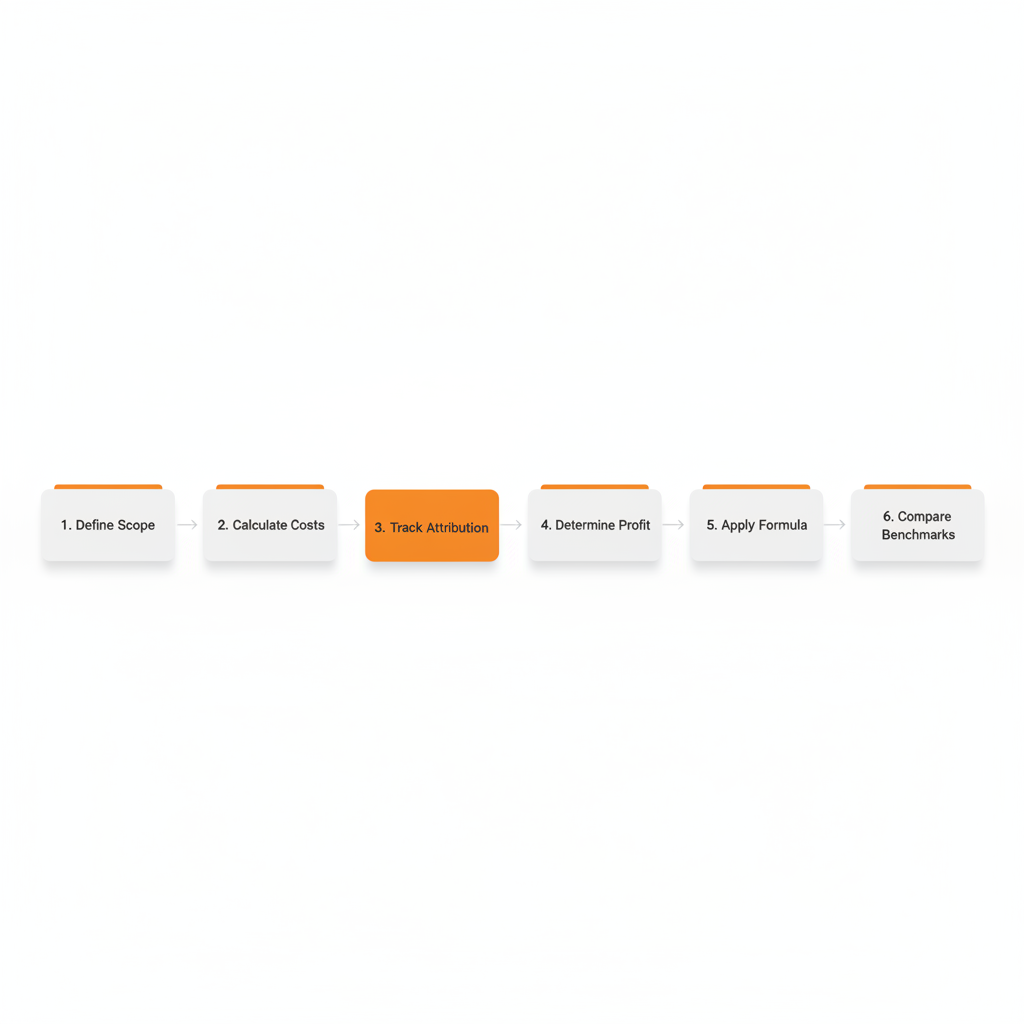
Step 1: Define Your Measurement Period and Scope
Decide what you are measuring before you start calculating. Are you evaluating:
- A single campaign (specific dates, specific channels)?
- A channel over time (all email marketing for Q1)?
- Total marketing performance (all activities for the year)?
Be specific. “Marketing ROI” means nothing without scope.
Step 2: Calculate Total Marketing Investment
Gather every cost associated with your defined scope:
| Cost Category | Examples |
|---|---|
| Direct spend | Ad budgets, sponsorships, tools |
| Labor | Salaries, freelancers, agency fees |
| Production | Design, copywriting, video |
| Technology | Analytics platforms, marketing automation |
| Overhead | Office space, equipment (allocated %) |
Do not skip indirect costs. They affect real profitability.
Step 3: Track Revenue Attribution
This step separates accurate ROI from guesswork. Implement:
- UTM parameters on every marketing link. Use a link management tool to maintain consistency.
- Google Analytics 4 configured for conversion tracking
- CRM integration connecting marketing touches to closed revenue
- Consistent naming conventions so data stays clean
Without proper tracking, you are estimating, not calculating.
Step 4: Determine Net Profit from Campaigns
Subtract costs from attributed revenue:
Net Profit = Attributed Revenue – Marketing Costs
For product businesses, also subtract COGS:
Net Profit = Attributed Revenue – COGS – Marketing Costs
Step 5: Apply the ROI Formula
Use the formula appropriate for your situation:
Basic: (Revenue – Cost) / Cost x 100
With COGS: (Revenue – COGS – Cost) / Cost x 100
CLV-based: (CLV x New Customers – Cost) / Cost x 100
Example calculation:
- Campaign spend: $10,000
- Attributed revenue: $45,000
- COGS (35%): $15,750
- Net profit: $45,000 – $15,750 – $10,000 = $19,250
- ROI: ($19,250 / $10,000) x 100 = 192.5%
Step 6: Compare Results to Benchmarks
Context matters. Is 192.5% ROI good? Compare against:
- Your historical performance (is it improving?)
- Industry benchmarks (5:1 is considered strong)
- Channel-specific averages (email at 36:1 vs. PPC at 2:1)
ROI without context is just a number.
What is a Good Digital Marketing ROI?
A 5:1 ratio (500% ROI) is considered strong digital marketing performance across most industries. This means earning $5 in revenue for every $1 spent on marketing.
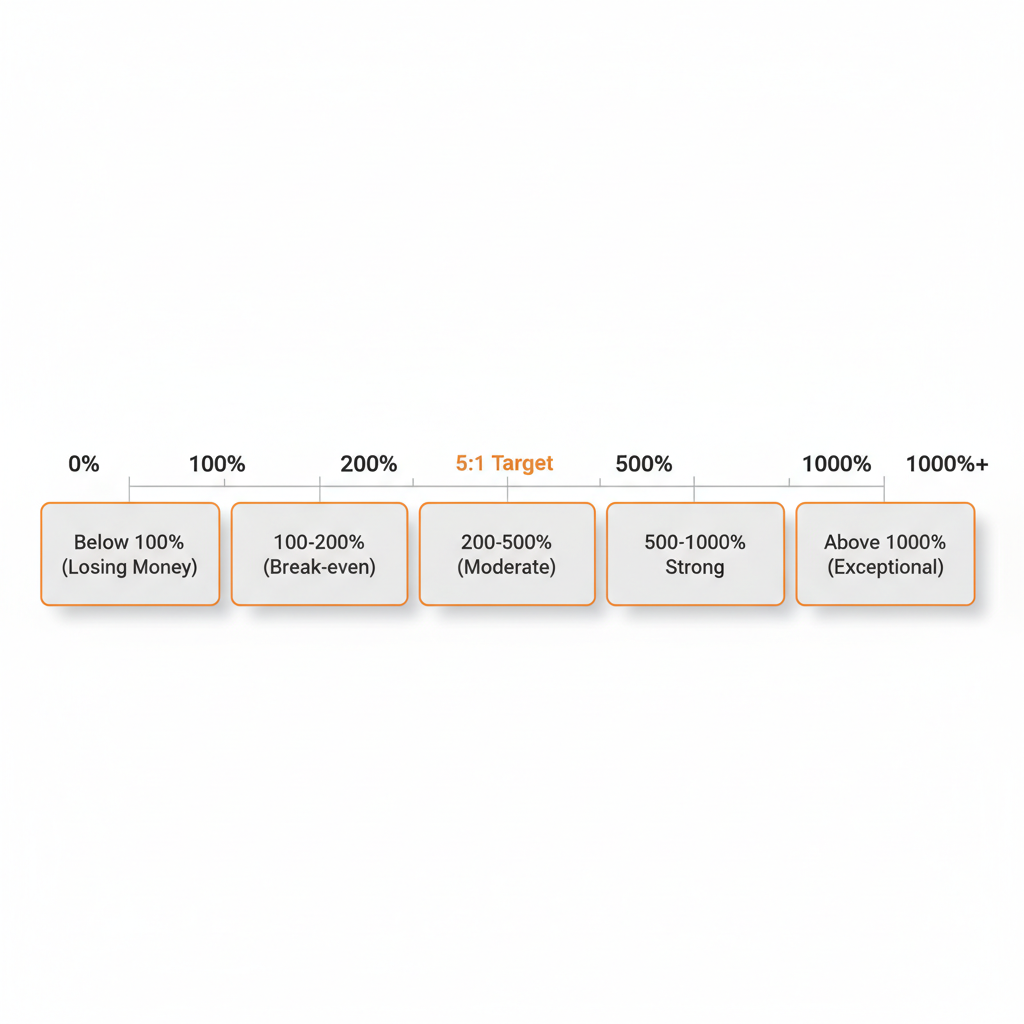
Here is how to interpret different ROI levels:
| ROI Level | Ratio | Interpretation |
|---|---|---|
| Below 100% | < 1:1 | Losing money, needs immediate attention |
| 100-200% | 1:1 to 2:1 | Break-even to weak, covers costs but minimal profit |
| 200-500% | 2:1 to 5:1 | Moderate to strong, sustainable performance |
| 500-1000% | 5:1 to 10:1 | Strong to exceptional, scaling opportunity |
| Above 1000% | > 10:1 | Exceptional, but may indicate under-investment |
The last point surprises many marketers. If your ROI is consistently above 10:1, you may be under-spending. You have proven the channel works. Now is the time to invest more and capture additional market share before competitors do.
Industry variations exist. B2B typically sees lower ROI but higher deal values. E-commerce sees higher volume but tighter margins. Benchmark against your specific industry and business model.
Common ROI Calculation Mistakes (And How to Avoid Them)
Even experienced marketers make errors that distort ROI calculations. Avoid these pitfalls:
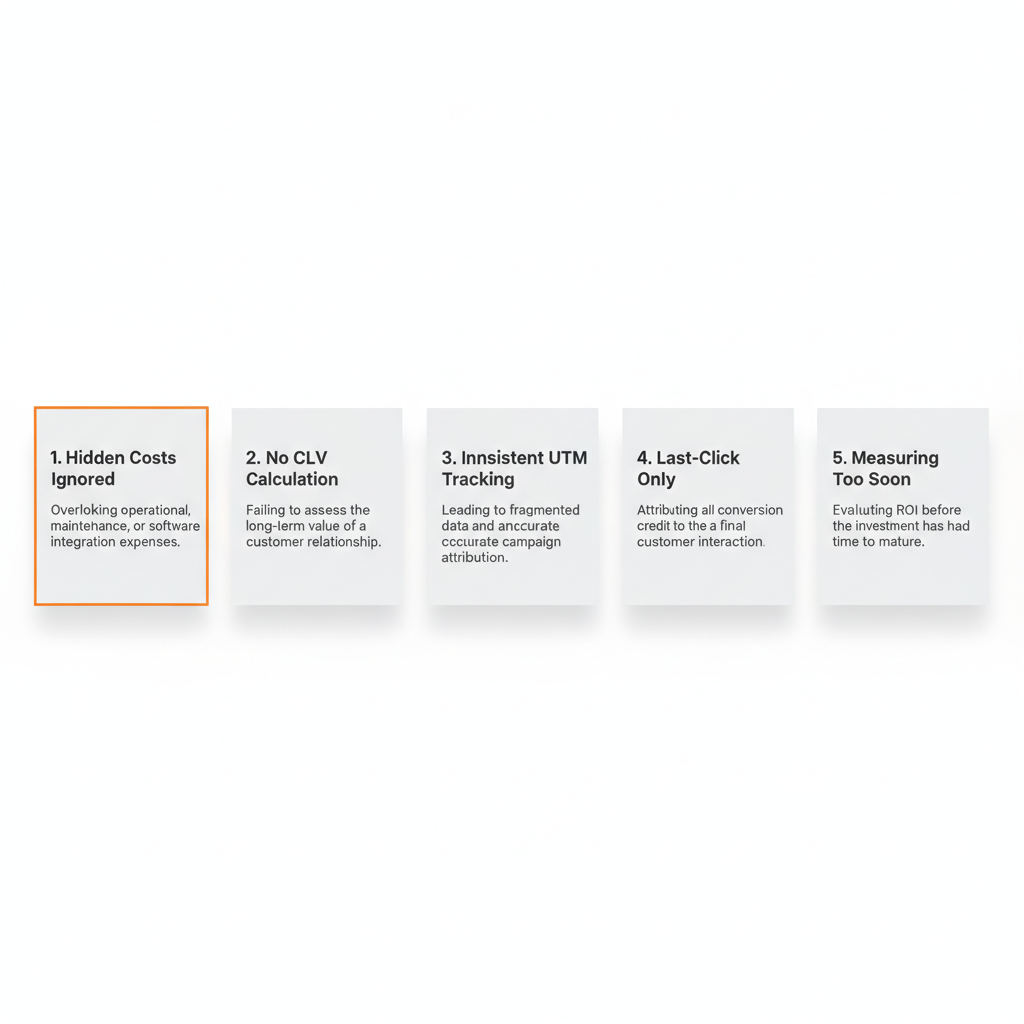
Mistake 1: Forgetting Indirect Costs
Only counting ad spend while ignoring salaries, tools, and overhead inflates ROI dramatically. A campaign that looks like 500% ROI might be 150% when all costs are included.
Fix: Create a comprehensive cost template that includes every expense category.
Mistake 2: Ignoring Customer Lifetime Value
If you sell subscriptions or have repeat customers, single-purchase ROI massively undervalues your marketing. A customer acquired for $100 who spends $2,000 over three years is far more valuable than the first transaction suggests.
Fix: Use CLV-based ROI for businesses with recurring revenue.
Mistake 3: Inconsistent UTM Tracking
Using “Facebook” in one campaign and “facebook” in another creates separate data entries. Using “email” for some campaigns and “newsletter” for others fragments your attribution.
Fix: Implement strict naming conventions and use a UTM management platform that enforces consistency.
Mistake 4: Relying on Last-Click Attribution Only
Last-click attribution ignores the awareness and consideration stages that make final conversions possible. It over-credits bottom-funnel channels and under-credits top-funnel efforts.
Fix: Implement multi-touch attribution or at minimum, review first-click data alongside last-click.
Mistake 5: Measuring Too Soon
Calculating SEO ROI after one month guarantees disappointing results. Content marketing takes time to rank and compound. B2B sales cycles extend for months.
Fix: Align measurement windows with channel characteristics and sales cycles.
Tools for Tracking Marketing ROI
Accurate ROI calculation requires the right tools working together.
Google Analytics 4
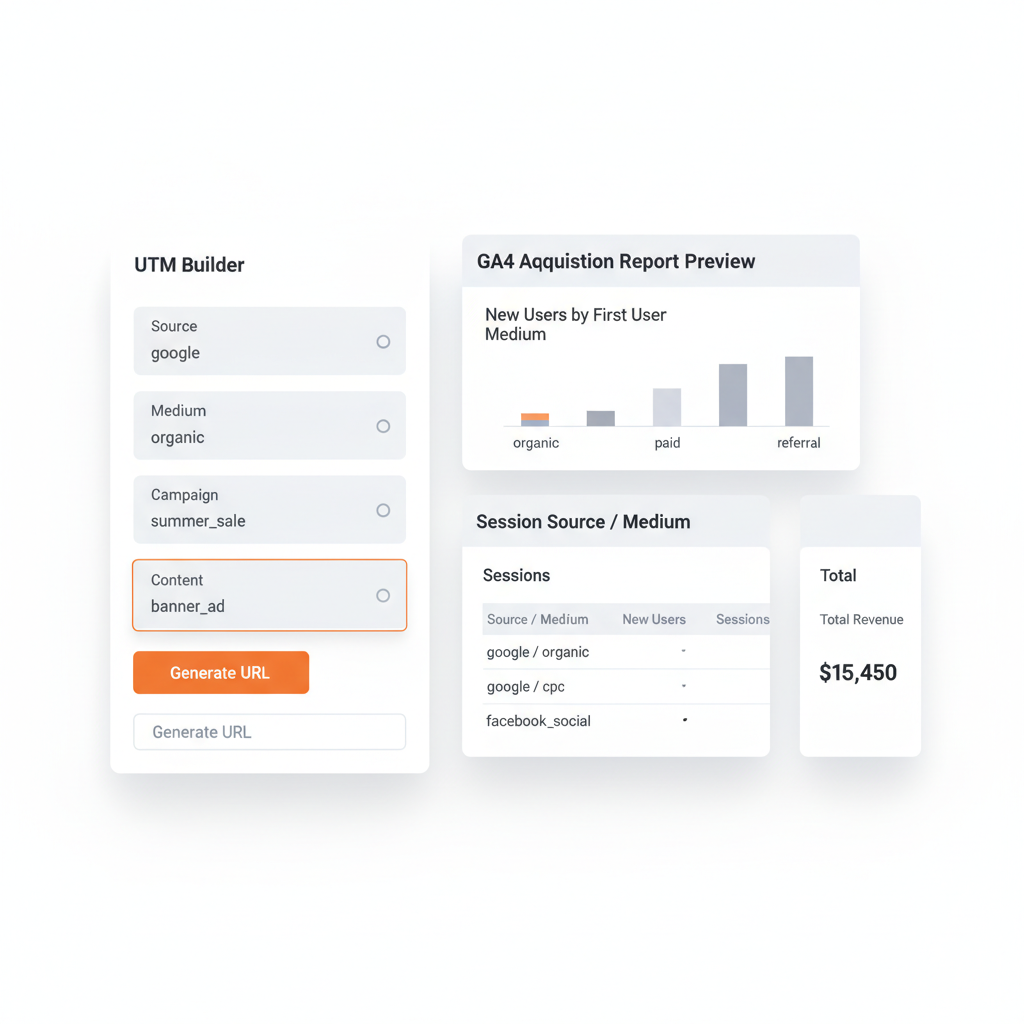
GA4 provides the foundation for tracking website traffic, conversions, and revenue attribution. Configure conversion events, connect to Google Ads, and use the acquisition reports to see channel performance.
UTM Link Management
UTM parameters tag your links so GA4 can attribute traffic and conversions to specific campaigns. Without consistent UTM tracking, your ROI data has holes.
linkutm solves the consistency problem by:
- Enforcing naming conventions automatically
- Providing templates for common campaign types
- Integrating directly with GA4
- Enabling team collaboration with shared standards
Manual UTM creation in spreadsheets leads to typos, inconsistencies, and fragmented data. A dedicated tool eliminates these errors.
Marketing Automation Platforms
Tools like HubSpot, Marketo, and Klaviyo connect marketing activities to CRM data, showing which campaigns influenced which deals. This closed-loop reporting is essential for accurate B2B ROI.
Spreadsheet Templates
For smaller teams, a well-structured spreadsheet can calculate ROI effectively. Include columns for all cost categories, revenue attribution, and automatic formula calculations.
Start Tracking Your Marketing ROI Today
Calculating digital marketing ROI comes down to three fundamentals:
- Know your costs – all of them, not just ad spend
- Track your attribution – use UTM parameters consistently
- Apply the right formula – match calculation method to business model
A 5:1 ratio remains the benchmark for strong performance, but context matters. Email at 36:1 and PPC at 2:1 can both be successful depending on your goals and industry.
The biggest mistake is not calculating ROI at all. Marketing without measurement is guessing. And guessing does not win budget approval conversations.
Start with one campaign. Track every cost. Tag every link. Calculate the return. Then expand from there.
Ready to build the tracking foundation that makes accurate ROI possible? Try linkutm free and start creating UTM-tagged links that feed clean data into your analytics.
—
Digital Marketing ROI FAQs
What is the formula for digital marketing ROI?
The basic digital marketing ROI formula is: ROI = ((Revenue – Marketing Cost) / Marketing Cost) x 100. For example, if you spent $5,000 and generated $20,000 in revenue, your ROI is 300%. This means you earned $3 for every $1 invested in marketing.
What is a good ROI for digital marketing?
A 5:1 ratio (500% ROI) is considered strong digital marketing performance across most industries. This means earning $5 in revenue for every $1 spent. ROI below 2:1 indicates inefficiency, while ROI above 10:1 may suggest you are under-investing and missing growth opportunities.
How do you calculate ROI for email marketing?
Calculate email marketing ROI using this formula: ((Revenue from Email – Email Marketing Costs) / Email Marketing Costs) x 100. Include costs for email platform, design, copywriting, and list management. Email marketing averages 3,600% ROI, making it one of the highest-performing digital channels.
What is the difference between ROI and ROAS?
ROI (Return on Investment) measures overall profit after all marketing costs, while ROAS (Return on Ad Spend) measures revenue generated per advertising dollar. ROI uses net profit in its formula; ROAS uses total revenue. Use ROI for profitability analysis and ROAS for ad efficiency optimization.
Why is marketing ROI hard to measure?
Marketing ROI is challenging because of multi-touch attribution (customers interact with multiple channels before converting), long sales cycles, offline conversions that cannot be tracked digitally, and dark social sharing. Using UTM parameters and consistent tracking helps overcome these attribution challenges.
How do UTM parameters help measure ROI?
UTM parameters are URL tags that track exactly which campaigns, channels, and content drive traffic and conversions. They provide first-party attribution data that feeds directly into Google Analytics 4, enabling accurate revenue attribution by source. Without UTM tracking, ROI calculations rely on incomplete data.
How often should I calculate marketing ROI?
Calculate marketing ROI monthly for ongoing campaigns and after completion for specific initiatives. Weekly tracking works for high-spend PPC campaigns. Allow adequate time for conversions, as SEO and content marketing may take 6-12 months to show full ROI while email and PPC show results within weeks.
What costs should I include in marketing ROI calculations?
Include all direct costs (ad spend, agency fees, tool subscriptions) and indirect costs (team salaries, overhead, content creation, design) when calculating marketing ROI. Excluding costs inflates ROI artificially. For accurate measurement, track every dollar invested in the campaign being measured.